Om Namah Shivaya

Om Namah Shivaya

I'll be grateful if you...

Showing posts with label Up Close and Personal. Show all posts

Nov 30, 2014

UP, CLOSE & PERSONAL: The Gypsy Goddess - Meena Kandasamy

THE GYPSY GODDESS - A THUNDERCLAP OF A NOVEL

From Hindu lit festivals, to constant ongoing word wars on social media, I have been watching Author Meena Kandasamy's journey to becoming a fiction writer of repute, for some time now. Her book ‘The Gypsy Goddess’, seemed to me, giving voice to her restrained rage against passivity of society at large. In this powerfully crafted novel, she gave vent to her angst in most interesting and witty way, taking us on a journey, exploring one of the most heinous massacres in Nagapattinam at Kilvenmani, where in 1968, 44 dalits were burnt alive by the landlords. 

Click here to buy the book at Amazon
Although, she writes in her book, that Kilvenmani is a season ticket for journalists who want to make a pilgrimage into people’s memory, that writing an annual one-page article salves not only your conscience but also everyone else’s; this book is not going to be a salve to your conscience but an unwrapping of the bandages from distant past and expose a festering wound for all to see, feel and react to. And not to let, in her own words “the coppery sick-sweet smell of charred flesh: a smell like nothing else, a smell that was almost a taste, a smell that was meant to be smuggled to the grave”, it to be buried in sands of time; in the graves of modern Indian history.

When our book club, Sans Serif (which meets at Apparao Gallery every month), decided to discuss the book ‘The Gypsy Goddess’ by the author, Meena Kandasamy, I reached out to her and she enthusiastically agreed to join us for a discussion with the members. On the day of our meeting, I picked her up from her house and on the way, we happened to talk about Rishikesh, Kedarnath (My favorite places in Himalaya), where she spent almost a month shooting for a Malyalam movie Oraalppokkum, in which she is playing the female lead 'Maya'. I was happy to hear when she said that it was one of those places, where she did not have nightmares. 

In the opinion of our book club members, the Author Meena seemed to be quite vulnerable rather than the impresssion and the tag 'Ms Militancy', she is usually associated with.

Moderating the discussion with Meena Kandasamy at San Serif Book Club
Apparao Art Gallery - Chennai

THE GYPSY GODDESS

As you start reading the book, your preconceived notions of blood and gore, given the background of the book, based on a horrible massacre, is immediately destroyed with her introduction. Author Meena disarms your bias with her charming words, painting the canvass of the book with her incisive wit. The usual impressions of typical Indian villages, comes out to be in a stark contrast...

Meena Kandasamy @ Hindu Lit Festival
Pic taken by me
“Famed for its large chariot and its buxom Devadasis, the temple at Tiruvarur once ensured that both gods and men were assured of a good ride. Then there’s a temple for the pubescent Neelayadakshi, the only Tamil Goddess with blue eyes. Clearly, some in the steady stream of visiting white men had spilled their seed”.


As you read on, you realize that her freshness of style, not only comes from the fact that it’s her first novel, (so she can choose to experiment with her writing) but also from being an outspoken poet, translator, an active firebrand 'Ms Militancy' in real life as well as on the social media platforms.

“Some poets are utter losers, unreliable when it comes to facts and incapable when it comes to fiction. … I am just spreading out the mattress on the riverside, setting up the landscape, inviting you dear reader, to join me and look beyond the trauma, with the aid of (such) romantic imagery.”

It was a real delight to read her thoughts on the style of her writing, as she takes the reader ‘head on’, getting them ready for anything down the road.

“Sorry… Here (in my book), I simply push them (my characters) off the page. Don’t bother asking me about authorial decorum and all that jazz. I am not running for Miss Congeniality. I stopped practicing politeness in tenth grade. Because I have taken pleasure in the aggressive act of clobbering you with metafictive devices, I can hear some of you go: what happened to the rules of novel? They are hanging on my clothesline over there.

Finally, as she gets ready to drag the reader through the murky waters of feudalism, caste wars and injustice, littered with raw images of poverty and exploitation, she lets you know that her experiences with the medium has made her wiser.

“Initially I wanted to put this section on poets and rivers down as a footnote and forget all about the fictional elements. Last time I wrote a footnote, however, I made the mistake of suggesting that Ponnar and Sankar, two local guardian deities, were Arundhatiyars, an oppressed untouchable caste, and a case was slapped on me by the touchy touchable caste – Hindus seven years after the book appeared.”

Author in discussion with book club members...
Reading the book, I felt closer to the dark reality that was seemingly so far off for those of us, who live in Metro Chennai, a part of the modern India, where, like every other urban city, the public memory is notoriously short. Though, in this write up, I would not like to discuss the politics behind the massacre, the ferocity of feudal landlords or the helplessness of the poor peasants as Meena Kandasamy is a far better person to do that, but I would like to say that it is one of the most difficult book to write. Meena has done a great job in conveying convey the texture, feelings and helplessness of the time, truthfully.

She says, “Even if we stylistically try and recreate the texture of every other old-maids tale, we must remember that hate is not always obedient to plot. It has ambition, it believes in unlimited possibilities and places its trust in tangents”. And she excels, in not letting her ferocious angst take over the book instead she shows us the mirror of our times - oblivious to the suffering of the poor, downtrodden and unjust politics etc.

“… and in desperation a mother throws her one-year-old son out of the burning hut but the boy is caught by the leering mobsters and chopped into pieces and thrown back in and in that precise moment of loss and rage every one realizes that they would dies if their death meant saving a loved one and that they would die if their death meant staying together and that they would die anyway… and together they prepare to resign themselves to the fact that they have mounted their collective funeral pyre.”

Arthur Schopenhauer has once said…
“Truth that is naked is the most beautiful, and the simpler its expression the deeper is the impression it makes ".

For me that was the reality of the book.  Meena Kandasamy reached out to the readers, with simple truth being told as it is. She has perfectly captured the aftermath of the massacre through the eyes of Inspector Rajavel, who made the First Information Report (FIR) of the incident, without being pretentious…

“…only a cold-blooded sadist could have come up with an instruction to the reporting of police officer to note down the facial expression of a fire victim.”

In the end, I would like to share some of the lines from the book that got me thinking. …
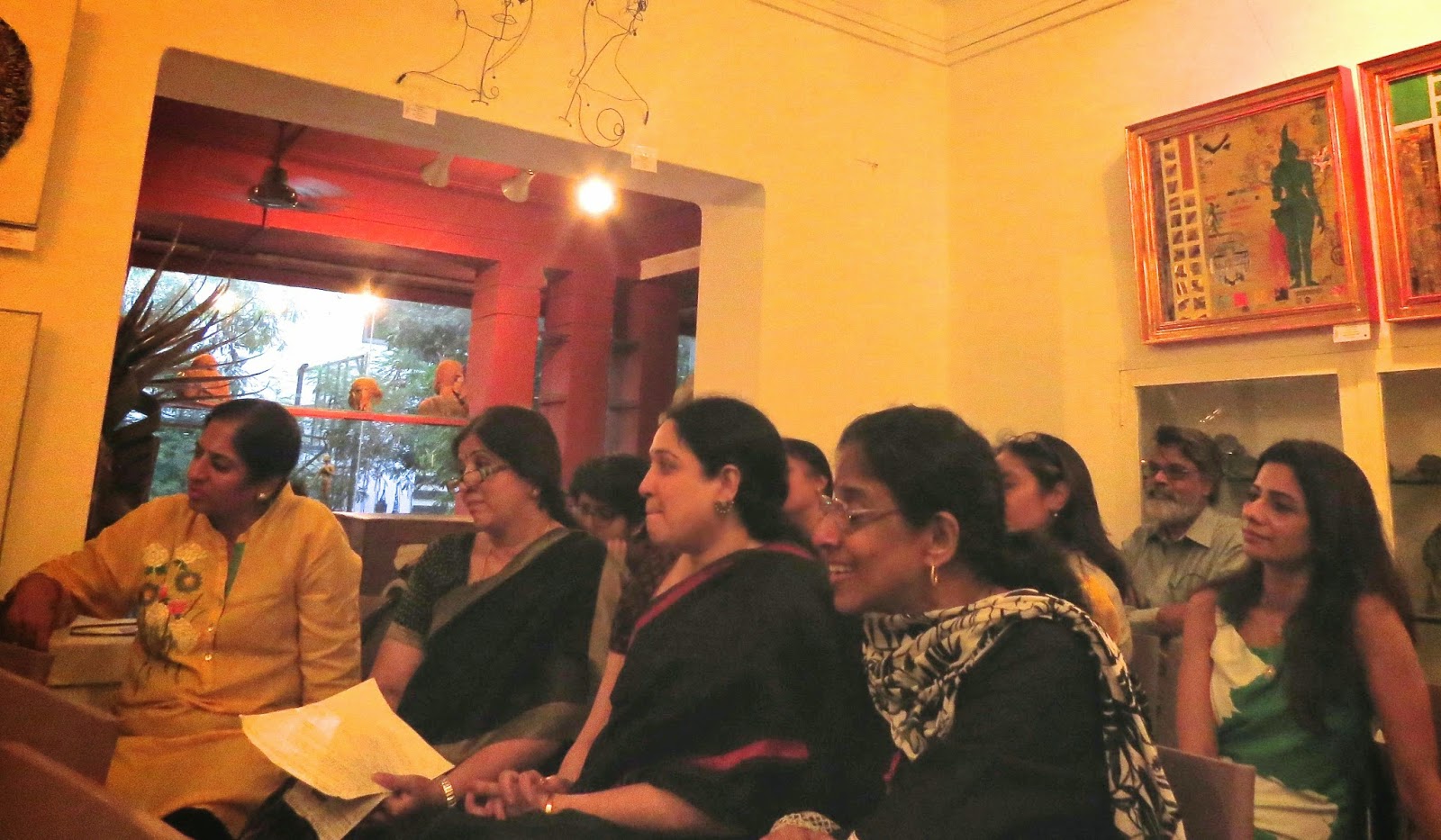
Listening to Meena Kandasamy at Sans Serif Book Club...
FROM THE BOOK: THE GYPSY GODDESS

What is a story worth if it does not have a supernatural element? Why begin when you can not bring in the Gods.

Words transform when they travel through a medium. They die, but worse they can kill. In a novel like this, there is no point in shooting the messenger dead. In the village of Kilvenmani, pannaiyal Subramanian is the linkman. … It’s through him that they receive their threats; it is through him that they learn that their end is near. Like the fool of all folklore, this man will survive and stay unscathed.

Revolutions are usually verbose and, sometimes, they make too many promises.

Don’t you even try to get familiar with what goes on around here, for it is not only the sounds of my native land that you will find staggering.

I was in the mood for some Dostoevsky that day, my mind was swinging with my mood and, reminding myself that men were despots by nature, I maintained an icy exteriors, almost as if I was frozen by fear.

It would be cruel not to appreciate Inspector Rajavel’s labors, and criminal to suppress the facts of the massacre. Therefore his observations have been shared hereunder, and the tabulation shall tell this tale.

Anger prevents Kilvenmani from disorienting itself, Maayi sees how the anger keeps the people together, injects them with life, provides them a reason to live, pushes them to action.

Because all of us are afraid and the fear in our hearts slurs the truth in our voices.


__
Shashi
नमः शिवाय
Om Namah Shivaya
PREV                                HOME                              NEXT
Chanakya Returns by Timeri N Murari              Satan's Letters from Earth

Aug 19, 2014

Up, Close & Personal: Chanakya Returns by Timeri N Murari

UPDATE: 
It is my honour that Timeri N Murari wrote introduction to my first Spiritual Fiction "Songs of the Mist" published in Dec, 2015
____
Over the year, it has been my pleasure to meet and interact with Timeri N Murari, a Chennai based novelist, journalist, playwright and screenwriter; whose best seller ‘Taj’ has been translated into 25 languages. His screenplay of the award-winning Hindi movie Daayraa (1997) was voted one of the ten best films of 1997 by Time magazine. The first time I met him at our book club ‘Sans Seriff’ at Apparao Gallery, where he gave a talk on his pilgrimage to Mount Kailash - “Limping To The Center Of The World” (To read review of the book, please click here).

Pic Curtsy Aleph Publishing
In our discussion at the time, he has remarked about his characters, “Once the story starts growing, one character starts taking over” and this is what is the ‘central character’ of his latest book, ‘Chanakya Returns’ which was recently launched at Odyssey in Chennai.

The book is about Ancient Guru Chanakya, (an Indian teacher, philosopher, and royal advisor to the Emperor Chandragupta) who is reincarnated in the body of a Character Mohanlal who is just a lowly clerk in the beginning. And as the story grows, Chanakya slowly seeps into a powerful position of the top political family of the country, as the trusted and capable advisor to almost everyone in the family. From the beginning, the story anchors you with a deep thoughts and beautiful description of power play, of love and betrayals.

“Love, I advise, and I speak from experience, is a fragile as rotting silks and will disintegrate when infidelities, jealousies, betrayals, impotence infect it. The heart is not to be trusted as it is brainless and mistakes lust for love while the loins mistake love for lust" – says Chanakya in ‘Chanakya Returns’

The way Chanakya works his political machinations within the family is powerful as well as amazing insights into the working of a psyche.

"I lean over, my mouth near the delicate curves of her right ear, and whisper my Shastras. … In sleep a whisper enters the deeper caverns of the mind and lodges there in the crevices and folds of the reason and thought to guide the prince. Of course, he can ignore every word, that is free will, but it is my duty to keep repeating myself in the hope he listens and acts accordingly."

Timeri N Murari announcing the winner of Hindu Literary Prize 2014

I really enjoyed the journey through the political landscape that Tim Murari has created within the book, which could be placed geographically anywhere in South East Asia. When I asked him about this ambiguity, he says, “I did not want it to be identified with any one political party” But I am biased towards reading it from the point of UP and Bihar, a place that I come from. The Family in ‘Chanakya Returns’, of course have an uncanny similarity to the Family Politics that these places have been suffering from since Independence.

.. and the ending is beautifully crafted into an intriguing choice and revelation, leaves you asking for more and probably we might get it too, as Tim Murari informed me in our subsequent discussion.
"Death is not the end, it is the beginning of actions. It always alters the pattern of the lives of those who survive it."

Finally, I would like to share one of the things that Tim Murari feels quite strongly about. The plagiarizing of the real Chanakya’s Book ‘Artha Sastra’ etc. by famous Italian thinker Machiavelli. He makes it a point to say, through the character Chanakya in his book “My life’s work, my treatise on state craft, Arthashastra, was stolen by that Italian plagiarist, Niccolo de Bernardo dei Machiavelli”.

Now I will leave you with some of the thoughts from the book, which I could relate to at deeper level. But before that, here’s…

A brief Biography of Timeri N Murari
(Text Curtsy Timeri N Murari)

Timeri N Murari in conversation at Hindu Lit Festival 2014

Timeri N. Murari began his journalistic career as a police reporter on a small town newspaper in Canada before joining The Guardian in London. For 15 years, he wrote features and interviewed the famous, from Gloria Swanson and Melina Mercouri to Paul Newman and John Fowles. He has also written for The New York Times, The Washington Post, The London Times, The Observer, The Hindu, Indian Express, Penthouse and other magazines. He wrote his first novel in 1973 and has since written 18 others, four non-fiction books including a memoir, MY TEMPORARY SON, and on his trekking pilgrimage to Mount Kailas, LIMPING TO THE CENTRE OF THE WORLD. 

He also has made Television documentaries for British TV on Homicide detectives in the South Bronx, Texas Cowboys and black families in the American deep South. ‘THE SQUARE CIRCLE’ (Daayra) a feature film which he wrote and co-produced, was chosen by Time magazine as one of the top 10 best films of the year in 1997. He later adapted it for the stage and directed the play at the Leicester Haymarket Theatre. Parminder Nagra played the main lead. His novel THE TALIBAN CRICKET CLUB was published in eight countries. Aleph publishes his new novel CHANAKYA RETURNS July 2014.

Text Curtsy: Timeri N Muri

THOUGHTS FROM ‘CHANAKYA RETURNS’ BY TIMERI N MURARI


Timeri N Murari at our Book Club 'Sans Seriff'

Power is to be pursued. It is an aphrodisiac, it is unending hot sex of 1001 positions, it is magical, it is miraculous.

Heat of women’s loins melts men’s minds.

“The world’s biggest power is the youth and beauty of a woman” Arthshastra

Power and love are incompatible, for power cannot trust the love offered up to it on a gold platter. Men and women are devious serpents in a pit, coiling and uncoiling their calculations to win the love of power.

We are democratic country and we need our dynasties.

Thoughts needs silence, only the sounds of nature, the sigh of the wind, the call of a bird, the rustle of leaves, truly inspired me ...

I have not revealed my true identity to anyone as I know, from my previous existence, that when you are among strangers, you need to keep your true self a secret. You never know who is the friend and who is the enemy.

Its easier to inherit a throne than to win one by an outsider.

We have thousand ways to communicate in this day, but mostly with nothing wise to say, only the babble of disjointed thoughts.

Love is full of porous holes; it will drain away in time.

Democracy is always a famished beast that needs constant nourishment. (Fill the party coffers)

Hope, even if false, is better than being forgotten. No medication can purge love; the sediment clings stubbornly to the walls of a heart.

Sex is a contagion, once tasted, once explored, once sated, it devours the mind and the body.

Even time has not an antidote for such a sweet poison (love).

So common are the statues of Gandhi that he has been rendered invisible.

Self delusion is the charming trait of humans, we will ourselves into the hallucination.

Happiness is as brief as a wisp of breath, fragile, lasting a few seconds then vanishing. Think the thought ‘I am happy’ and you have driven it away.

Love is not happiness, it’s more a physical feeling centered in the heart and the mind, and thinking on love does not banish it. It can last a day, two days, a lifetime.

When you are young, daydreams nourishes you.

Memory plays tricks on all of us. It’s like the wet clay that you can mould into any desired shape to fulfill a fantasy, to recreate a better version of what occurred so many years ago. We believe that what we wanted, what we yearned for in, that mysterious zone below the surface of our thoughts, lie the dreams that we create which, after the passage of years, rise to the surface.

Aren’t our fantasies more comfortable than the heart break of reality?

…Love is watery. But water also has the power to submerge and wear down rocks.

Children understand love better than adults, which is why we regress when we fall in love. They know the happiness of receiving it and also the pain and disappointment when it is withheld.

Have you considered that even the universe could be puzzled by its own existence and searching for its creator? It wants an explanation for why it came into sudden being in five seconds, when it had been sleeping peacefully for an eternity.

In democracy the art of assassination has to be more subtle and revolves around the destruction of the rivals character…

There is some self interest behind every friendship. This is a bitter truth. Friendships are love affairs not consummated in bed but in classes, bars, on playing fields, on long journeys and they fill the void of loneliness that we all experience in this life. The bitterest betrayals are not between lovers or families but friends. They are our companions on this journey and when they vanish into dust and ashes, we know our own time nears. 

They are the last milestone we pass before the end.

Love is as vicious a weapon as power; it can gut the heart, wrench it out and stamp on it.

Always keep your secrets secret.
___________
I hope you have enjoyed reading my take on this lovely book, if you would like to know more about the book or the author then do get in touch or leave a comment... It will be my pleasure to respond or connect you with the author....
__
Shashi
नमः शिवाय
Om Namah Shivaya
PREV                                HOME                              NEXT
Limping to the center of the World - Timeri N Murari        The Gypsy Goddess - Meena

Jul 25, 2014

UP, CLOSE & PERSONAL: DAYANITA SINGH – THE DIGITAL DIVIDE

A BOOK MAKER WHO USES PHOTOGRAPHY AS HER VOCABULARY…

DAYANITA SINGH is the first Indian to have a solo show at London's famous Hayward Gallery in 2013, who vehemently refuses to use Digital Cameras and computers to design and create her books. She loves making her books by her own hand, armed with scissors, knives of various form and sizes with scotch tape, instead of Cntrl+C and Cntrl+V, which is the usual way the 21st century world works in almost every field now.

THE DIGITAL DIVIDE....
Dayanita Singh and T M Krishna before
the book launch
Her latest book FILE ROOM is, in my opinion, symbolizes the Digital divide that’s making creativity into something common and superficial. Now you find smart phones capturing images, in every situation, instead of living those moments of 'now'. And as she says, in introduction for the book…

FILE ROOM
… is an elegy to paper in the age of the digitization of information and knowledge.
Image from the book File Room (Curtsy Dayanita Singh)
When I got invite from Sharan Apparao of the famous Apparoa Gallery in Chennai, for the launch of the book – File Room by Dayanita Singh, I had no clue that I am going to have an ecstatic journey through the labyrinths of creative minds. Minds? Well, I did forgot to mention that I actually went to hear T M Krishna, the famous Carnatic music vocalist, who was launching the book “File Room”.
Go Away Closer
Curtsy Dayanita Singh

I have had heard of Photo journalists, Photographers of different genre like Fashion, Sports, Digital etc. but I had absolutely no idea what is photographic artist is, till the time I heard Dayanita Singh talk about her journey. From studying to become a script designer at NID, to Documentary Photography and finally to creating books with the script of analog images (for those, who have not used or even seen those big bulky camera’s with actual ‘physical’ film rolls and the infinite wait to see the results, it’s like the difference between e-book and physical book that you can hold close to your heart, while you dreamily fill your vision of love mixed with sighs of the characters from the book).

But before I go about sharing my impressions from the talk by those two amazing artists, let me give you a brief bio…

Dayanita Singh is a bookmaker working with Photography. She was born in 1961 in New Delhi. She studied Visual Communication at the National Institute of Design in Ahmedabad and Documentary Photography at the International Center of Photography in New York. She has published ten books: Zakir Hussain (1986), Myself, Mona Ahmed (2001),Privacy (2003), Chairs (2005), Go Away Closer (2007), Sent a Letter (2008) Blue Book (2009) Dream Villa (2010), Dayanita Singh (2010) House of Love (2011).


T.M. Krishna (born in 1976) is a Carnatic music vocalist. Krishna's first concert was at the age of 12, at the Spirit of Youth series organized by The Music Academy, Madras. Since then, he has travelled widely in India and abroad and given over 2000 concerts all over the world, performing regularly in major international music festivals. He has performed at prestigious venues including the Kennedy Centre, Theatre de la Ville, The Esplanade, Sydney Opera House, Chowdiah Hall Bangalore, and The Music Academy, Madras.

As the program started with the launch of the book by T M Krishna where he spoke about the book and his impressions, beginning with a beautiful question. Why a particular photograph is called Black and White Photography. As an artist, he felt that the Black and White encompasses all the colors in between. It’s for the viewer to see all the colors, and they do see all the colors, that those two contrasting colors bracket in.

Then moved on to highlight, probably the best impressions that captured the essence of the book “File Room”. He says that as he went through the images, it represented something like his mind, where if you open one file, many different files opened simultaneous (just like the synaptic connections of nerves firing within) and left the viewers with a feeling of finding that story which is unique to him or her.

As Dayanita Singh rose to speak, she was visibly happy to see that some one at least know
Dayanita Singh
Pic by KVSRINIVASAN
what’s her book is all about. She spoke about her incredible journey to be what she could be. Her creative journey started with an accident as for her class project, she was asked to capture different moods of a person and she chose to shoot Zakir Hussain, who was performing in a concert at IIM Ahmadabad. As she prepared to take her first picture, she was pushed by the security in the jam-packed hall and fell on her back, which fortunately did not broke anything other than her pride. As she went out to give vent to her frustrations, she found Zakir Husain, walking around (at the time he was not so famous). She reached out to tell him, ‘Some day I will also be a great artist and then no one will be able to push me’. And Zakir Husain calmed her down and asked to her come to his morning riaz (practice) and take as many pictures as she wants. Dayanita said that night was the life changer for me and made me realize what I want to do in life. From this encounter, and travelling with his troupe for 6 winters as a student photographer her first book came out in 1986 …

ZAKIR HUSSAIN
A teacher, as she said, who instilled in her, a desire to work 18 hours a day and stay focused.

Curtsy Dayanita Singh
The other teacher that influenced her life was an eunuch, Mona Ahmed, who was staying in a cemetery. A work assignment for London times (which eventually never happened as Mona Ahmed thought that she is from New York Times and felt that if it gets published in London, where many of her friends are, will find it not in good taste, so took all the rolls from her and dumped it in trash) got them together, which lasted a lifetime. But eventually Dayanita created an amazing visual biography of a double outcast Mona Ahmed through the words written by herself and portrayed by the analogue images from Dayanita Singh, known as...

MYSELF MONA AHMED
A mix of photobook, biography, autobiography and fiction, Myself Mona Ahmed (Scalo, 2001) keeps renewing its importance in Dayanita Singh’s oeuvre because of the direction in which her work is evolving.

Curtsy Dayanita Singh

And throughout her lectures she kept the audience enthralled with her easy talk and ready wit, interspersed with her fine, overpowering images being displayed on the projector.

To read an excellent report on the launch please do read "Where Images Do The Talking" by Elizabeth Mathew

At the end of the launch, as an amateur photographer myself, I tried to capture her through my smart phone (hated it, when I realised that I forget to bring my camera). But then how do you go about taking photographs of someone who is the world’s renowned photographer herself… well here are the results.

Behind the scene ...
Dayanita Singh And T M Krishna
A cameraman prepares for the best portrait
Wondering if that's the best way...
Finally I leave you with some of the books and photographs of Dayanita Singh that captured my imagination.

GO AWAY CLOSER
Go Away Closer is a novel without words. It concerns series of opposites in Singh’s India: presence and absence, reality and dreams, tradition and progress. She is able to express the emotion underlying these often abstract concepts, because her photography springs from her own intimate experiences.
HOUSE OF LOVE
"House of Love" is a work of photographic fiction that takes the form of nine short stories. Working closely with writer Aveek Sen, whose prose follows a journey of its own, Singh explores the relationship between photography, memory, and writing.
Text and Image curtsy Dayanita Singh
DREAM VILLA
In Dream Villa Singh explores how the night transforms what seems ordinary by day into something mysterious and unsettling.

Text and Image Curtsy Dayanita Singh

BLUE BOOK
Blue Book is a series of images made during Dayanita Singh’s wanderings in the industrial landscapes of India. Presented by Dreamvilla Productions, India (an alias and nom de plume designed to mask Singh’s authorship), the book will be displayed in galleries and museums as a work of art.
Blue Book - Text and Image Curtsy Dayanita Singh

PRIVACY

What can a photographer in India capture on film other than disasters or the exotic? Dayanita Singh was preoccupied by this question after she had spent many years documenting the poverty in her homeland. Her answer was a return to the world from which she came, to India’s extended, well-to-do families and their fine homes.


Text and image curtsy for the books - Dayanita Website
___

Shashi
नमः शिवाय
Om Namah Shivaya

PREV                                     HOME                                       NEXT
Limping to the center of the world - Timeri N Murari             Sufi Singer Abida Praveen


Related Posts Plugin for WordPress, Blogger...