Om Namah Shivaya

Om Namah Shivaya

I'll be grateful if you...

Showing posts with label Haiku. Show all posts

Dec 21, 2016

THOUGHTS THIS WEEK: Silence and the space between thoughts

“We live our life in the steps, not at the end. When the time is right, we will find our space in universal design. That space is the reality of our consciousness; rest is layers upon layers of memories, desires, and insecurities of mind. The problem is that within these layers, we lose the sense of our purpose and drift along like the clouds in the sky, inadvertently bringing rain or sunshine in our lives. But if we dive deeper into the awareness of our being, we will find the true purpose of our living.” says the Monk in “Songs of the Mist


All my loneliness
Is nothing but flowering
Silence of being

And within these layers is that one layer, the space between thoughts, the meditative silence where we can regain our balance, our purpose and live whole some life. A life of an awareness that give us an anchor which will stop us from drifting away.


In reality, the life is lived not in memories but in the moment that is passing by, in the work that you are doing, or in the thoughts that you are thinking. If we learn to live in those moments with a silence that is eternal, we can be forever alive.


Bamboo shoot in deep
Embrace; Echoes of silence
Caressing dew drops

And a deep stillness is attained in the end, just before another journey begins. The stillness of being at the precipice of another fall or at another endless beginning, our nature itself becomes the seed for another tree or another river to burst forth. In this creative surge coming from the depths of eternal silence, is the key to our happiness.


Happiness is not a function of wealth or possessions but the ability to love all that is around us and knowing that we are loved through our creation. Yes, every one is loved by some one, somewhere... As the seeds of  our meditative silence between thoughts, actions and creativity, creates new life, new idea or new beginning. It all burst forth through our own silent self... 


Eternal bliss
In the depths of inner being
Flowers of our soul

__
Shashi 
ॐ नमः शिवाय
Om Namah Shivaya


PREV                                HOME                              NEXT
The Happiness Hack

Dec 11, 2016

HAPPINESS HACK: Nature of life and love...

HACKING YOUR WAY TO HAPPINESS
As we take tentative steps of living day to day, we forget to realise that without a sense of belongingness, kindness towards all that we have been blessed with and inner flowering of love, it just brings us closer to an end....


We carry the ego, the pride and the pleasures every day as we have not realised the freedom of unburdened living. In our thoughts, we are tied to the ground of small pleasures and achievements in cocoon of our minds, without realising that we have hidden  wings under the shell, ready to break free like a butterfly.... and see the beauty of life that is all around in our being...


But then we forget that flying alone is not the freedom, the colors of being but the essence of our soul lies in belonging... in flowers of love.


Because in the end, the reality lies in the nature of love rather than the logic of mind...


__
Shashi 
ॐ नमः शिवाय
Om Namah Shivaya

PREV                                HOME                              NEXT
On Writing Fiction                       Silence and the Space Between Thoughts

Sep 13, 2016

Chennai Colors: N Lingusamy - Haiku Writer, Director and Producer of Tamil Movies

(Chennai Colors is a section of my blog in which I share the colors and hues of creativity from the thought leaders of the city who make our Chennai, a beautiful place to live in.)
 
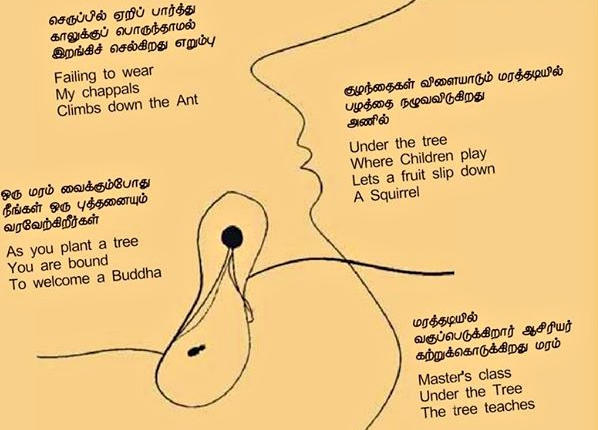
Digital Art by Lingusamy

Pebbles reflect
The cutting edge power
Of the stream

 - A Haiku by Lingusamy

When the famous Tamil Movies director, producer and scriptwriter N Lingusamy called me to meet, I was sure that it would be a short curtsy visit to discuss our mutual passion of writing Haiku. But as the day went by, I realised that its going to take some time. He has a disarming charm that makes the words flow and time moved on swiftly. Our interaction went on like his words above, which some times floods the banks with its powerful surge and some times shape large boulders into beautiful sculptures. In the end, it proved out to be a wonderful sharing of thoughts with one of the creative personalities of Chennai. 


Few days earlier, I had received Director Lingusamy's call. He had heard about my own passion for Haiku from our mutual friend Ashwin of Odyssey Book Store. He wanted to have some views on his Tamil Haiku, which was translated into English by one of his friends. After the call, he sent me some of his Haiku and as I liked most of them, I was looking forward to meet him.

As we sat down to share our mutual experience on writing Haiku and discuss the beauty of world’s shortest poetry form, I could feel Director Lingusamy’s enthusiasm and focus on all things creative. He had also  called some of his colleagues and a little later his fellow Director, scriptwriter and poet - Brindha Saarthy also joined in, which made it more like a poetry session.

But before I go further, here is a little information about this very creative Chennai personality - N Lingusamy. Personally, I believe he has added a spark to the Chennai city with his smart, action oriented, story based movies which has captured the imagination of movie goers across the state.

A Brief Note about Director N Lingusamy
Narain Linguswamy made his directorial debut with the Mammootty starrer family-drama Aanandham in 2001 and followed it up with films Run (2002), Sandakozhi (2005), Paiyaa (2010) and Vettai (2012). He and his brother N. Subash Chandrabose have also produced films through his production company, Thirupathi Brothers.

Lingusamy hails from a village Lakshmipuram in Tamil Nadu. He joined as an assistant director to director A. Venkatesh for his Tamil film Mahaprabhu and followed in his next film Selva. He had also assisted Vikraman in Vaanathaippola, a family drama on brothers.

Although Lingusamy has worked in Tamil only, his films have been dubbed or been remade in other languages too. Dubbed Telugu versions of Run, Sandakozhi and Paiyaa, titled Run, Pandem Kodi and Awara, respectively, were released in Andhra Pradesh and also became commercially successful.[33][34] Aanandham was remade in 2005 as Sankranti by Muppalaneni Shiva in Telugu, while Jeeva remade Run in Hindi under the same title in 2004. His Paiyaa was remade in Bengali in 2012 as Jaaneman, while in 2013, a Telugu remake of his Vettai titled Tadakha was released.
- From Wikipedia
_________
As the morning progressed, I noticed the subdued beauty of the living room. Dir Lingusamy usually has his creative sessions with his team and informal discussion with his friends in this room, where many of his digital paintings added to the color. The little butterflies on the French window, opening out to the little ‘Buddha’ kind of garden gave a feeling of serenity. As an interior design professional I liked the place. I could also feel the inherent energy of the room, which I am sure added to his creative out put.

Director Lingusamy started writing his poetry from college days and without realizing that he is writing world’s most popular form of poetry -Haiku, he stuck to the style. His first Haiku, which is reproduced below, was published in a famous Tamil Magazine as well.
 
Digital Art by Lingusamy

To the Man
Ironing the cloth
Wrinkles in his belly

This Haiku was inspired by watching an old person, who was ironing shirt in the by lanes, around his college. He still remembers the day clearly, as he was spending some free time with his college friends. The image stuck in his thoughts as he realised that the old man was in the process of removing wrinkles from the clothes of others, while incapable of removing creases of poverty and deprivation from his own life.
 
An English translation of Lingusamy's Haiku is going to be published
shortly by one of the new and upcoming publisher from North Indian
"Story Mirror"
Writing Haiku is meditation for me and that’s what comes across from Lingusamy thoughts as well. During our discussion, as we shared our Haiku and creativity in general, it was quite clear that in those inspired moments of creativity, he needs to be alone. With the seed of a thought growing into a sapling of creativity, he shuts himself away from the entire hustle bustle around. He likes to be alone to focus on capturing those  images of life within his words.
 
Some of the Tamil Haiku - Translated into English

Over the years, Lingusamy has written 100s of verses and shared with me a beautiful Haiku, which was an outcome of a particular moment while he was constructing his house.

He told me that as soon as he entered the half constructed house, few of the sparrows who had made it their home, flew off in a flutter of activity…
 
Digital Art by Lingusamy
Still unfinished
Building my home
Sparrows already moved in

As the day moved on, we had a beautiful connection through our own mutual passion. Brenda Sarathy also shared some of his poems as well as explained in detail what he thought of Director Lingusamy's Tamil Haiku. After a while, I realised that Lingusamy was like a friend, with whom one can go on talking and sharing thoughts to understand our own expressions in deeper way. He was like a friend, who instinctively understands and appreciate the subtleties and depths of one's creative outpouring. Looking forward to many more such sessions of creative discussions and sharing of thoughts.


As I prepared to move on, he presented his special Edition of Haiku, to remember the lovely day spent with him. I look forward to the English Edition of his verses - Linku II.

_____
Some of the personalities featured in Chennai Colors section of the blog...
Dr. Anita Ratnam
Dr. Chithra Madhavan
Anitha Guha
Renie Ravin

__
Shashi 
ॐ नमः शिवाय
Om Namah Shivaya

PREV                                HOME                              NEXT
IndiBlogger's Renie Ravin                        


Aug 26, 2016

10 Tips on Writing Haiku - Story Mirror Creativity Workshop

I have had recently shared my “Ten Tips on Writing Haiku” in Story Mirror Creativity Workshop which was organized in association with Story MirrorApparao Galleries and Aspiring Authors Group along with the famous Author, Timeri N Murari, who shared his insights on Writing for Plays. As many of aspiring authors and writers present in the workshop asked me to share my thoughts and tips on Haiku, I am writing this one post so that it is convenient for all to read and share.

Poster : Story Mirror, Haiku by Shashi

What Haiku means to me...?

I have been reading and writing Haiku for a long time and over the period, I have realised that it has more depth than some interplay of words, seasons or cutting words known as Kigo etc. For me…

It is painting pictures with words…
It is also a way of living with awareness…
It is also a kind of Meditation for me….

But before I go on to elaborate the above statements, let me give you a brief historical perspective on Haiku. It will help you to appreciate the beauty of the world’s most popular poetic form.

Haiku - A Brief Introduction
(For a detailed discussion, please read ‘UnderstandingHaiku - A Beginner’s Guide’)
As per The Haiku Society of America, a dictionary definition for Haiku is that these are the world’s smallest poems, consisting of 17 syllables arranged in sequence of 5-7-5. 

The classical poems were known as Waka meaning ‘Japanese poem or song’ in the 9th century which were mainly of two types – a long form called Choka and a short form known as Tanka. The opening 17 syllable stanza of Renga Session was known as Hokku which, later19th Century poet, Shiki gave the name as Haiku.

Basho - acknowledged as the supreme master of Haiku, believed to have said to his Zen Teacher that “Haiku are description of what is happening at a particular ‘haiku moment’.

Finer Points…
There are many elements that are intertwined within the verse to create a beautiful haiku. Some of the them are… 


Mystery and elegance (Yugen)

Stillness and solitude –
Sinking into stones,
The trill of cicadas
- Basho

Melancholy sadness and tranquility (Sabi and Shori)

On a withered branch
A crow has settled.
Nightfall in autumn.
- Basho

Or in the spirit of poetic madness (Fukyo)

Let me show you,
You market people,
This hat filled with snow.
- Basho

After Basho, there have been many great poets who took Haiku to the greater heights …

Buson
The bite of my axe.
Sudden revelation –
There is life in this tree!

As Buson accepts his death quietly in this farewell poem

White plum blossoms,
Night turns to dawn –
The time has come

Masaoka Shiki
A river in summer
There’s a bridge here, but
My horse prefers water

Now coming back to what Haiku means to me…
I believe that everything that comes in a flash of insight is potential Haiku. Holding on to that seed and then putting words around it in order to paint a picture; to make it a complete thought which forces a reader to reflect upon it, is what I feel ‘writing’ a Haiku is.

Here is a Haiku that I have had written years back, when in the backwaters on the outskirts of Chennai, I saw Herons, standing for hours together…


Under my feet
Path disappeared
Am I the destination?

Painting pictures with words…

Pain is
When you feel like
Stopping the sunrise


-This is the first line from my book “Songs of the Mist”, where Ashutosh, having lost his brother’s entire family to an epidemic, went deeper into despair. And one night, love of his life also leaves him sinking into hopelessness on the banks of Ganges. And as he opened his eyes, half submerged in the sand and silt of the the river, he felt that this dark night should not come to an end…

Living with awareness…
Over a period of time, Writing Haiku changed me; it gave me a deeper sense of things all around…


Meditation…
In the process of writing Haiku, I move into a deeper level of awareness, just like in Zen Meditation or by Mantra chanting

TEN TIPS ON WRITING HAIKU …

TIP 1: Be aware of your surroundings and the little happiness’s in life. Experience it fully and then the words would form automatically.

TIP 2: Look deeply and then with what you see as well as feel within, you should find words to paint a vivid imagery.

TIP 3: A Haiku becomes more powerful if it contrasts or aligns the nature with your own thoughts and feelings.


TIP 4: Use simple words. Words those come naturally to you. A haiku reflects your own personality in a vivid way.

TIP 5: Write, whenever a thought or words come to you as you are going about your daily life.

TIP 6: Write daily. Haiku for me works like a mantra chanting. Over the years it has slowly transformed me. So I write daily.

TIP 7: Try to write haiku in 3 lines, 5-7-5 syllable forms as it is generally accepted as the norm.

TIP 8: Count your syllables; there are many sites that will count the same for you.

TIP 9: There is a list of Kigo, known as Cutting word as well as seasonal words to be used in classical Haiku, available on the net. Use them as often as you can.

TIP 10: In the beginning, write with a picture. Try to capture the essence of it in words as I usually do. It helps.


__
Shashi 
ॐ नमः शिवाय
Om Namah Shivaya

PREV                                HOME                              NEXT
Understanding Haiku - A Beginner's Guide              Writing Fiction - Workshop II            

Related Posts Plugin for WordPress, Blogger...